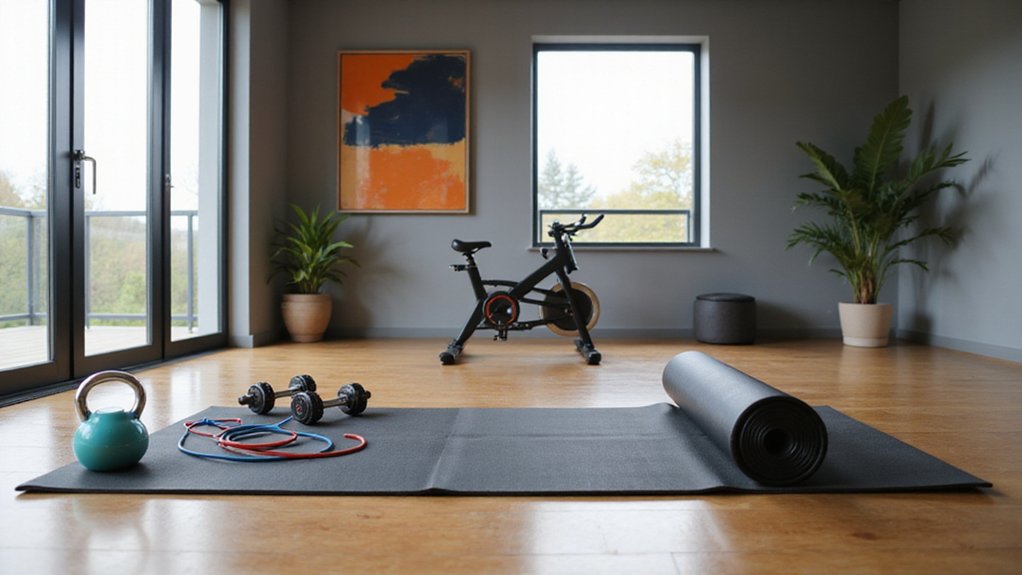
AI acts like your fitness sidekick, analyzing wearable data (heart rate, sleep) and goals to create workouts that adapt to you. Want to max your squat? Track your intensity and form—AI tweaks the plan mid-set if form tanks. Virtual trainers might swap squats for lunges on the fly while logging calories. Need recovery? Predictive algorithms flag overtraining risks. Stay motivated with gamified challenges or a virtual “you’ve-got-this” cheer. Input your mood and fitness level—AI nails the plan. Stop guessing, start crushing. Ready to perfect your squat now or see how AI turns frustration into form?
Highlights
- Assess fitness levels via AI analysis of sleep, movement patterns, and calorie intake for personalized baseline data.
- Generate adaptive workout plans using AI algorithms that adjust reps, weights, and exercise choices based on goals and progress indicators.
- Implement real-time adjustments through wearable tech syncing to monitor heart rate, form, and intensity, dynamically altering workouts during sessions.
- Prioritize injury prevention with AI sécurité that evaluates biomechanics and workload, suggesting form corrections and reduced intensity to avoid overtraining.
- Track progress and accountability by syncing AI with wearable data to review workout effectiveness, adjust routines, and maintain community-driven motivation.
Assessing Fitness Levels and Goals
Ever struggled to figure out how fit you actually are? Skip the guesswork: let AI do the heavy lifting.
Tools like Gyroscope and Uplift Labs drill into your data—sleep, movement patterns, calorie intake—to paint a clear picture of your current fitness level. Swap “I should probably run more” for concrete numbers, like reps lifted or strides taken.
Now, goal setting. Feel like you’re lost in a gym maze without a map? AI acts as your GPS: input “build muscle” or “run a 5K,” and apps like FitnessAI or Fitbod crunch your history to create step-by-step plans that adapt as you progress (no more plateauing).
Lost in the gym maze? AI becomes your GPS: input goals, know exactly what to do—adaptive plans, no plateaus, just progress.
Pro tip: treat fitness assessments like report cards—they’re not final, just data to level up.
Customizing Workouts With AI Algorithms
Ready to swap generic routines for plans that know exactly how you sweat and breathe? AI personalization dives deep into your fitness preferences – whether you hate burpees or refuse to lift weights heavier than your cat.
These algorithm-optimized systems don’t serve plain toast; they mix in your data-driven insights (knowing when you hit PRs or skipped squats last week) with real-time performance metrics to keep workouts fresh.
Share your goals – strength, endurance, or “just not dying on the treadmill” – and adaptive algorithms adjust reps, weights, or even suggest alternatives like rowing if your knees protest.
It’s like having a trainer who actually memorized your physique quirks and goal alignment (“Okay, you want bigger biceps but hate bicep curls – let’s try hammer grips with concentration…”).
*Boom.* No more boring, no more wasted reps.
Implementing Real-Time Workload Adjustments
Here’s where personalization kicks into high gear: your AI trainer isn’t just building magical workouts—it’s a hyper-responsive taskmaster**** that adjusts as you sweat, grunt, or *gasp* pretend you didn’t see that burpee coming.
Dynamic workload shifts happen mid-set—like when the AI notices your form’s slipping and suggests switching to lighter weights.
Adaptive algorithms track your pace, heart rate, or even selfie-style videos. If you’re crushing sprints, it’ll swap in harder drills. Dragging? It’ll ease up but never let you coast.
You think you’re the boss? *Nope.* It syncs with wearables (or your brutally honest “this is too easy/hard” feedback) to dial intensity up or down.
Miss reps? It recalculates your next set’s weight to match *your* limits, not some one-size-fits-most formula.
Wanna cheat? The tech’s watching—so better keep those squats deep until the timer beeps.
Leveraging Wearable Tech for Personalized Feedback
Your Apple Watch just got promoted to head coach. Armed with wearable sensors tracking your heart rate, movement patterns, and even sweat levels, it’s no longer just counting steps—it’s analyzing every squat, stride, or lunge.
These tiny gadgets create feedback loops that adjust workouts in real time: if your BPM’s too high, it suggests cooling down; if your sprints lack power, it cues better form.
Feedback loops dynamically adjust workouts: vigorous heartbeats prompt pauses, lackluster sprints trigger form cues—optimizing every rep for peak performance.
Need to up your treadmill game? Your watch turns drill sergeant without the shouting.
*Did the last set feel off?* It might nudge. *Try slowing down.*
Ironic, right? A device smaller than a cookie is now your toughest critic—personalized, patient, and annoyingly accurate.
Works smarter than yelling “Five more!” at a gym full of masked strangers.
Preventing Injuries Through Predictive Analytics
While you’re swapping sweat for selfies on your fitness tracker, tiny sensors are crunching data to predict when your body’s about to cry uncle.
That’s injury prediction through AI—think of it as your workout’s crystal ball. Tired legs? The algorithm flags biomechanical shifts, like a tottery running stride or wonky joint angles that scream “knee injury incoming!”
It’s no crystal ball; it’s data analysis drilling through stats like VO₂ max peaks, training intensity spikes, and even how your shoe grip wobbles on a damp track.
Who needs a Spartan diet when AI yells, “Hey, slow your roll!” before you turn a sprain into six weeks’ rehab?
Adjust your form, hack your workload, and let the numbers coach smarter—not harder.
Monitoring Progress and Recovery Metrics
Ever suspected your shoe might know more about your recovery than you do? Those smart sneakers *track your steps*, *sleep quality*, and even *heart rate* between lifting weights.
AI-formulated progress tracking logs reps, form, and strength gains—like a digital coach spotting your 100th plank. Over a week, it flags subtle changes: “You’re lifting heavier, but shorter sleep’s show in sagging squats.”
Recovery optimization springs to life: your wrist wearable *suggests skipping leg day* if bedtime was too brief. Yep, tech’s your new gym sidekick—tattling on your hydration, raging at overtraining.
Watch it pinpoint sneaky slumps: “Those 3 a.m. mouse-of-the-box rechecks *ain’t* improving your deadlift.” And? Sometimes “rest day” is the AI greasing your wheels.
Selecting the Best AI Tools for Your Needs
Ahhh, choosing the right AI workout tool—because who needs human coaches when you’ve got algorithms?
Start by listing your must-haves: bodyweight-only, gym equipment, or yoga chill vibes. Compare tools like JuggernautAI for AI strength, Nike Training Club for free variety, or Dr. Muscle’s science-backed plans.
Ask: *Do you need real-time adjustments or basic guidance?* Prioritize apps matching your equipment.
Then, cost-check: Freeletics and ChatGPT offer free options, while premium tools like Dr. Muscle ($49/month) or Fitbod ($12.99) give advanced tracking.
Think of it as a menu—choose apps that blend your budget, goals, and gym setup. Load up your phone, skip the human small talk, and let robots handle the sweatwork!
Advanced Techniques for Strength and Hypertrophy
Once you’ve picked your AI sidekicks for gym guidance, it’s time to level up with the *secret ingredient* in hypertrophy and strength training: advanced techniques.
Think of them as cheat codes to trick your muscles into growing faster. Progressive overload is your go-to move—adding weight or reps to keep muscles guessing.
Pair it with accentuated eccentric loading (slow, heavy lifts) for mechanical tension, or blood flow restriction (mini-cuffs + light weights) for metabolic stress without taxing joints.
Cluster sets let you cram more reps in fast—*like a Tetris marathon for muscles.* AI can cycle these methods automatically, sensing when your gains stall and swapping to supersets or drop sets.
Compare it to video game upgrades: drop sets = instant boost, pre-exhaust = boss battle prep.
Muscle adaptation? Your body’s opposition to boredom.
Let AI handle the science—your job? Lift with intent, rest hard. Wins follow.
Sustaining Motivation Through Adaptive Coaching
When skill plateaus hit (and they’ll – your body loves a good staring contest), adaptive coaching kicks in like a reset button for your fitness journey.
AI starts day one by nailing down specific goals – think “run a 5K” instead of vague “get fit.” It crunches your workout data to spot patterns you don’t: “Hey, you crushed leg days but skipped shoulders twice” triggers a renewed focus on balance.
Knees acting up? Your AI tutor auto-swaps heavy squats with chair-assisted alternatives while keeping momentum alive.
Think of it as your fitness roadie – not dictating, but setting up the perfect conditions for you to rock this.
FAQs
Can AI Fitness Coaching Lead to Legal Liability for Injuries?
Using AI fitness coaching can trigger liability concerns if injuries happen.
Even without human intent, your workout plans face scrutiny if they cause harms—like wrong moves leading to sprains or miscalculated intensity sparking rhabdo.
Subset injury claims if users blame your AI-generated advice. *Yes*, you’re liable for negligence here.
Cut risks: ditch the “AI made me do it” excuse, *always* use liability waivers specifying you’re not a medical pro, and invest in specialized insurance covering online training.
Like any coach, you’re legally responsible for safe guidance—even when robots write the plans.
How Secure Is Personal Health Data Processed by AI Tools?
Is your fitness data safer than a secret in a sauna?
AI tools can handle your health stats, but security isn’t bulletproof. Stick to apps using data encryption—think digital body armor for your workouts.
They should follow privacy regulations like GDPR or HIPAA (fancy terms for “we respect your data, don’t worry”).
But beware: even the best systems can leak. Like that time fitness apps accidentally revealed military base locations—yikes!
Always check if your app anonymizes info and updates software. AI might see your exercise habits, so treat it like a nosy trainer: share only what you’re comfy with.
Does AI Replace Human Trainers in Personalized Workout Advice?
AI can crush personalized workouts** with hyper-customized plans** and real-time adjustments – like a coach who never checks TikTok.
But human trainers still have tricks up their sleeve. Your AI app will suggest reps and weights, but when you wobble into a squat, humans catch the poor form first.
Need proof? AI might say “Sounds good!” while a trainer spots your knee collapsing and screams “STOP!”.
Pair them: use AI for smart programming, humans for the “oh-no” moments. Both? Game-changer. Just? Handy if you love lifting old paint cans.
Are AI Coaching Systems Held to Certification Standards?
Right now, AI coaching systems don’t face mandatory certification standards like human trainers.
But organizations like the ICF (International Coaching Federation) are creating voluntary guidelines to push developers toward safe, ethical practices.
These standards check things like accuracy, transparency, and inclusivity—think of them as “SEAL OF APPROVAL” stickers for responsible AI.
Still, there’s no government license required to sell AI fitness advice.
So while AI coaching regulations exist in some form, they’re mostly self-enforced by developers… which is kinda like trusting a robot to babysit a toddler without parental backup.
Your move, human? 😉
What Ethical Risks Exist With AI Health Monitoring?
Ever wonder what your health monitor AI knows?
Data privacy dangers lurk—if hackers breach the system, your heart rhythms, sleep cycles, and genetic info could be exposed.
Bias algorithms pose risks too—if the code’s trained mostly on majority groups, it might miss nuances in smaller populations (e.g., red flags ignored for women vs. men).
Always ask: *Who’s tracking your data?* *Is this advice one-size-fits-all?*
If your AI insists you face east for better sleep, question the science—because “smart” tech doesn’t always mean ethical.
Final Thoughts
“Okay, so you just got an AI workout coach — thump-fist-pump time! Ghost your old spreadsheets where sweat-stained notes ruled. Now, strap on tech that reads your heartbeats and sleep patterns like a fitness fortune-teller. Need to lift smarter? That smartwatch’s got biomechanical sensors judging your squats harder than gym rats. Want to avoid HIIT-induced back pain? AI’ll detect weird movement patterns, because even superheroes tweak form. Think of it as a hyper-attentive trainer who’s never too sore to spot you. Ready to bet on tech that’s got your back (and your deadlift)?”